

30 mm BK7 Risley Prism Pair / Optical Wedge Pair for Adjustable Laser Beam Steering
A compact pair of optical wedge prisms for variable beam deflection, laser alignment, optical bench experiments and educational demonstrations of Risley-prism beam steering.
Indicative shipping
| European Union | EUR 12 |
| Non-EU Europe | EUR 18 |
| North America | USD 60 |
| Rest of the world | Email me |

Product Description
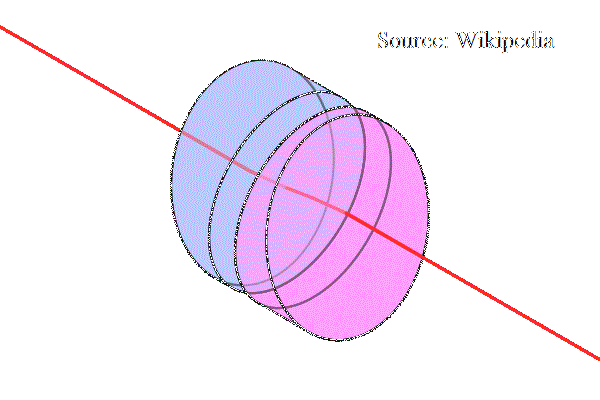
This is a pair of 30 mm BK7 optical wedge prisms, suitable for use as a Risley prism pair. When the two prisms are rotated with respect to each other, they act as a simple and robust variable beam deflector.
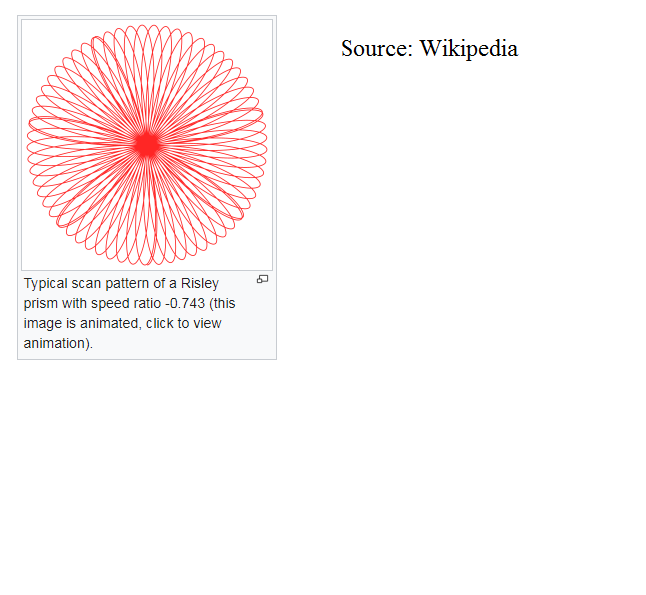
The main advantage of a Risley arrangement is that it can steer a laser beam without translating the optical components. Depending on the relative angular position of the two wedges, the beam deviation can be continuously varied from a nearly compensated position to the maximum combined deflection.
- Useful for optical alignment and laser beam steering experiments
- Suitable for optics benches, lab demonstrations and educational kits
- Compact passive optical component; no electronics required
- Can also be used as individual 30 mm optical wedge prisms
Technical Specifications
| Product type | Risley prism pair / optical wedge pair |
| Diameter | 30 mm |
| Material | BK7 optical glass |
| Wedge angle | approx. 5–8° |
| Approx. beam deviation | about 2.5–4.1° per prism, depending on wedge angle and wavelength |
| Maximum pair deviation | about 5–8° for similar wedges, approximate value |
| Coating | AR coated, unless otherwise specified |
| Condition | New old stock / unused optical components |
How a Risley Prism Pair Works
A single wedge prism deflects a transmitted beam by a small angle. With two wedge prisms in series, the total deviation depends on their relative rotation:
- Opposite orientation: the deviations largely compensate each other.
- Intermediate orientation: the beam is deflected by an adjustable amount and direction.
- Same orientation: the deviations add, giving the maximum beam steering angle.
Typical Applications
- Variable laser beam steering
- Laser alignment and beam-position correction
- Optical bench experiments
- Educational demonstration of refraction and vector beam deviation
- DIY optical scanner concepts
- Testing, prototyping and laboratory setups
The components are especially useful when a simple, compact and purely optical method is needed to change the direction of a narrow beam.